
Town of Wallkill Directory Shelves
Town of Wallkill nearly surrounds the independent City of Middletown. That geography makes Middletown collections valuable, especially for settled areas and postal connections, while also creating a real risk of a false match. A city entry may describe a city resident, a town parcel using a Middletown postal label, or a regional business reference. Compare the street, historic municipality, and later parcel geography before carrying a result into a Town of Wallkill family trail. The strongest local shelf is centered at Middletown Thrall Library, with additional film and research-room material at the New York State Library and Orange County Genealogical Society.
| Collection | Years | Where Held | Access |
|---|---|---|---|
| Middletown Directory, Hasbrouck volume | 1857-1858 | Middletown Thrall Library | Free digital facsimile and local holdings |
| Thrall Local History city-directory microfilm | 1871-1984 | Thrall Local History Room | In-library viewing, with coin-operated printing |
| New York State Library Middletown holdings | 1857/58; 1871-1931, 1933-1975, 1977-1979, 1981-1984 | New York State Library | Collection listing and film |
| Orange County Genealogical Society shelf | 1899-1952, incomplete | 1841 Historic Court House, Goshen | Research-room access |
| Thrall archival pages and advertisements | 1886-87, 1888, 1895, 1899, 1900, 1921 | Thrall archives | Archive search |
The New York State Library listing documents gaps in 1932, 1976, and 1980. It therefore supports a checked sequence, not an assumption that a new book appeared every year. Thrall identifies later materials as coming from various publishers; the research does not establish one publisher for every later volume.
Town of Wallkill Directory Beginnings
The earliest verified landmark is The Middletown Directory for 1857-'8, described on its title page as compiled from authentic sources. John W. Hasbrouck is identified there as the Middletown book and job printer connected to the volume. It is a useful starting point for a local surname, trade, or street clue, but its coverage remains Middletown-centered rather than a government list for the entire Town of Wallkill.
The digitized 1857-58 Middletown directory supplies a direct reading copy. The accompanying image shows the source in the form researchers encounter it, including its period typography and layout.
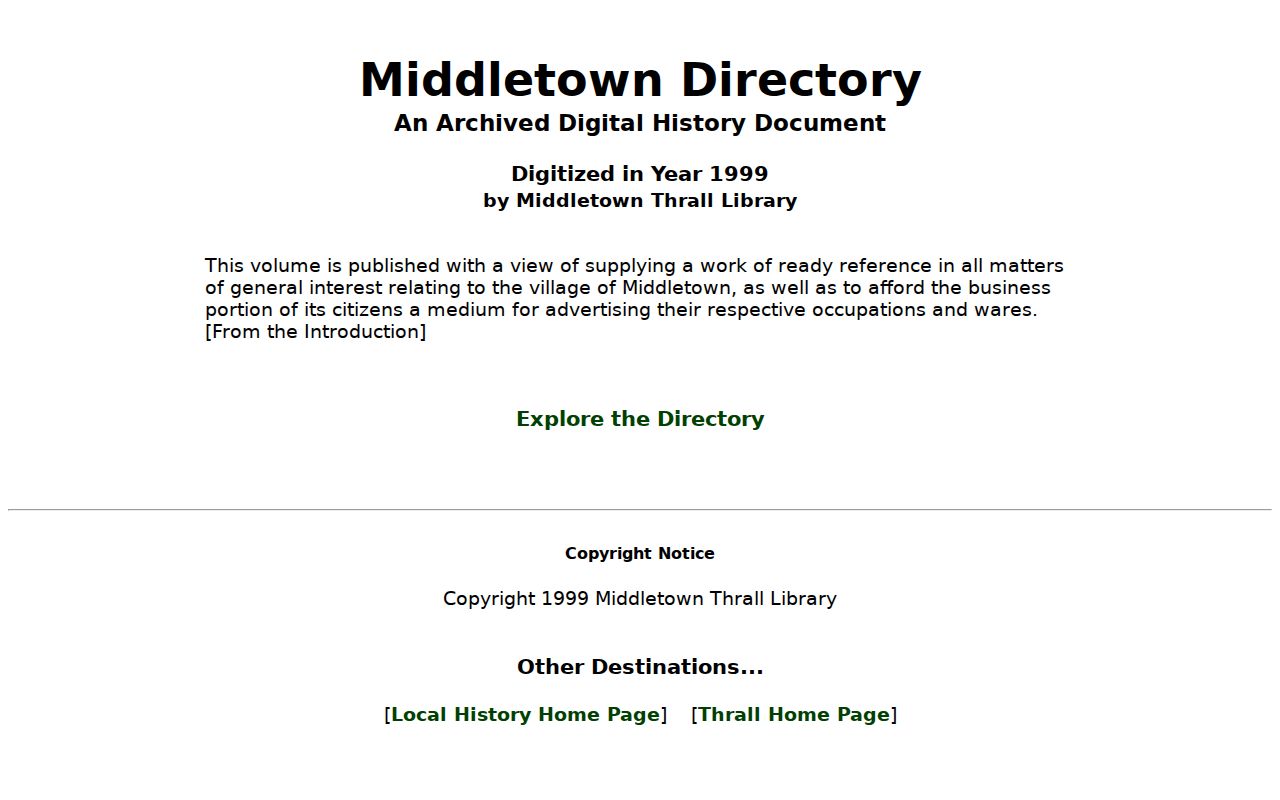
Use the facsimile to capture initials, occupations, and street wording exactly before comparing them to other records.
Town of Wallkill Directory Research Room
Middletown Thrall Library's Local History Department, at 11 Depot Street, is the main public-library channel for these collections. Researchers are asked to call or email ahead for local-history reference assistance, and appointments are strongly recommended because an unarranged visit may not be accommodated. The appointment line is 845-341-5483. Its holdings reach beyond historical directories to Orange County history, genealogies, church and cemetery records, railroads, historical texts, photographs, and local databases.
Some cataloged local-history material is noncirculating. The library also links its catalog, archive-text search, photo search, local-history topic search, and obituary database. For a Town of Wallkill name that is not in a directory, those channels can lead to newspapers, church material, or local family files instead of turning an absence into a conclusion.
The Local History Room source page explains the breadth of its collections and databases.
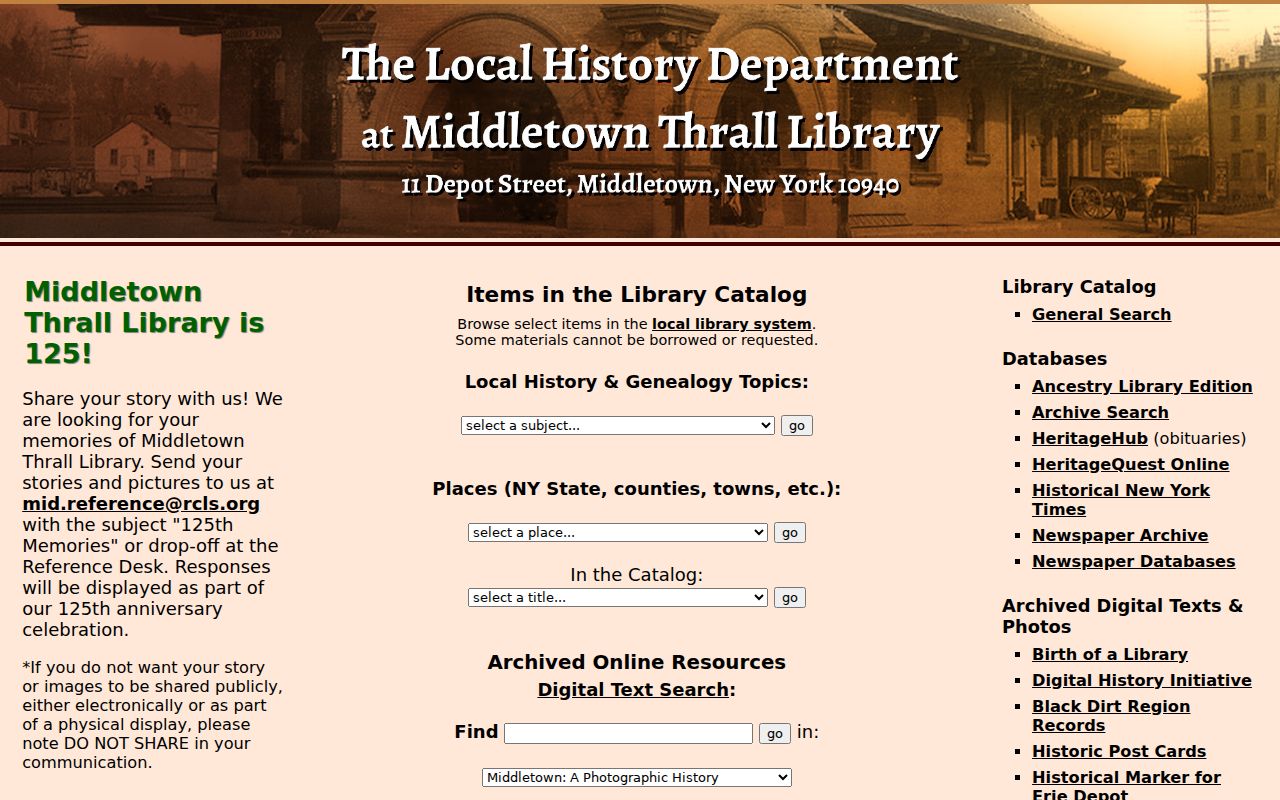
Calling ahead is especially useful when the desired historical volume is on microfilm or a related item is held in a noncirculating collection.
Reading a Wallkill Directory Entry
The sampled 1857-58 R/S page is specific enough to guide careful reading. Entries are alphabetized by surname and may include a given name or initials, an occupation, a business association in parentheses, and a street. Some entries give only name, occupation, and street. Many carry a printed r before an address. No abbreviation key was located in the inspected material, so its expansion should not be guessed. Copy the mark as printed and seek an explanation in the volume or repository notes.
| Name | Surname plus given name or initials under an alphabetical heading. |
|---|---|
| Work clue | Occupation such as printer, painter, carpenter, or grocer, when supplied. |
| Business link | A partnership or business association may appear in parentheses. |
| Street | Named street following the occupational or business detail. |
| Printed mark | Retain symbols such as r without inventing an expansion. |
- Householder index
- An alphabetical listing that helps locate a named person or household in a directory.
- Criss-cross directory
- An address-ordered companion volume or section, when one exists, used to approach entries by street rather than surname.
- Abbreviation key
- A publisher's explanatory list of short forms. It must be found in the same volume before a mark is expanded.
Town of Wallkill Directory Timeline
Known dates give the directory shelf a useful frame. They also show why the boundary between town and city must stay visible in a research note.
- 1772: the Town of Wallkill was established.
- 1848 and 1888: Middletown, once part of the Town, incorporated first as a village and later as a city.
- 1857-1858: Hasbrouck's Middletown directory provides the earliest verified local directory landmark.
- 1871-1984: Thrall documents city-directory microfilm across this span, with separate gaps confirmed in the state-library listing.
- 1990s to early 2000s: Thrall's Digital History Initiative put selected texts and photographs online while retaining originals in the Local History Room.
The chronology does not prove a continuous Town of Wallkill run. It does provide a defensible sequence for setting a search year and choosing the right repository.
Tracing Wallkill Directory Households
A household trail is stronger when every step preserves the original wording. Historical volumes can show a move, business change, or surname spelling, but a directory householder is a lead rather than proof of ownership. Match that lead to census, land, obituary, church, or probate evidence that answers a separate question. For current address-keyed records, the Town of Wallkill streets reference describes the property and parcel route.
- Search the alphabetic volume for each known spelling and record initials, occupation, business text, street, and printed marks.
- Check the next confirmed year at Thrall, the New York State Library, or OCGS. Do not fill a documented gap with an assumed annual issue.
- Use a street or ancillary listing only when the source actually contains one, and keep an occupant separate from an owner.
- Pair directory years with OCGS federal census film for 1790-1880 and 1900-1930, or its 1825-1875 New York census film by town.
- Compare a proposed owner with County Clerk land material and assessment records; compare a household with obituaries, church sources, probate, cemeteries, or newspapers.
- When the city shelf has no result, move to Town-specific OCGS publications, town census material, County Clerk indexes, church sources, or County Historian referrals.
Disappearance from one volume can reflect a move, death, a changed listing practice, or an incomplete run. A second independent source is needed before drawing a family conclusion.
Town of Wallkill Directory Companions
The Orange County Genealogical Society Research Room is in the 1841 Historic Court House at 101 Main Street in Goshen. Its local value includes master surname indexes, family folders, working papers, and Town of Wallkill publications on vital records, census, draft lists, and area obituaries. Monday hours from 9 a.m. to 12:30 p.m. do not require an appointment; Wednesday and Friday mornings require one, and the first-Saturday schedule varies with programs. Call 845-294-5871 before a special trip.
OCGS provides a second directory shelf, but its Middletown and Port Jervis material from 1899-1952 is incomplete. It also holds the parallel census, deed, probate, mortgage, naturalization, marriage, and newspaper index material that helps test a directory finding. This is the right pivot when an entry needs to become a documented family relationship or property history.
The Historical Society of Middletown and the Wallkill Precinct supplies another local-history route.
The society, at 25 East Avenue in Middletown, holds artifacts and images and is normally open Wednesday from 1 to 4 p.m.; verify before visiting.
Town of Wallkill Directory Name Variants
Local files at Thrall preserve useful indexing variations, including Coquillette and Cokelet, and Wholeben and Woolever. A city-directory search should try the recorded form, a plausible alternate spelling, initials, and an occupation or street where one is known. That approach is more precise than treating a single failed exact-name search as proof that a family was absent.
Thrall's obituary database is an index of obituary references for Middletown and nearby areas, generally about 1981-1988 with earlier coverage added over time. Its basic search uses one keyword field, while advanced search includes surname, first name, birth and death fields, maiden or married name, city fields, and publication date. It is a citation finder, not necessarily a full obituary image.
Note: Preserve the source citation and page or film position, because the same surname can occur in more than one Orange County household.
Town of Wallkill Directory Before Print
Older research has a different shape. The Historical Society of Middletown and the Wallkill Precinct holds a National Archives-listed 1798 Direct Tax Particular List for Wallkill, Deer Park, and Minisink. It is a named resident and tax-list lead far earlier than the web land index, not proof of an online name search. The County Historian directs family-history and cemetery questions to OCGS, and vital, land, deed, mortgage, map, and naturalization questions to the County Clerk.
For property context, the County Clerk points to FamilySearch deed books and grantor/grantee indexes for 1703-1900, while OCGS has grantor and grantee index microfilm for 1703-1891. These sources can establish whether a directory address belongs to the same parcel trail, but the directory itself remains the place to read the household's contemporary printed listing.